
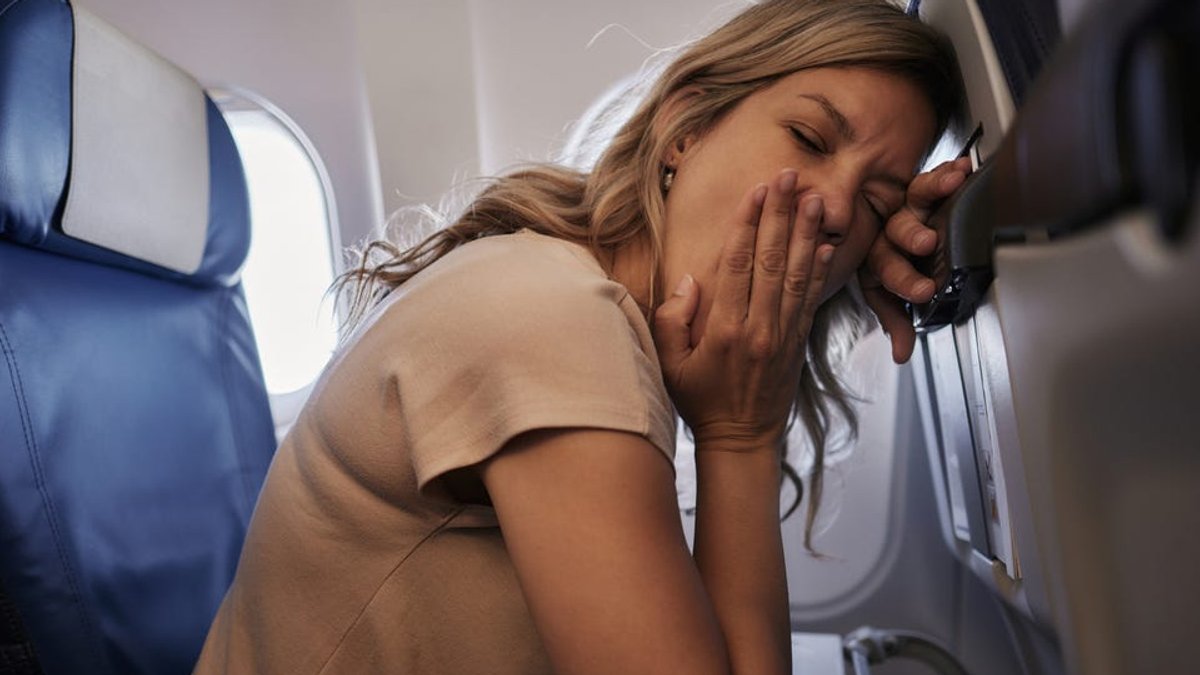
Even if I don’t always fall asleep on a plane, I’m lucky that I’m decently compact and can fold myself into a narrow economy seat without much trouble. My latest one, the SeaWheeze Half Marathon, is on the West Coast in Vancouver, British Columbia, while I’m based on the East Coast in Easton, Pennsylvania—which puts a six-hour flight and three time zones between me and the starting line. I’m from the Czech Republic, a country in central Europe six time zones east of my current home, which I visit at least once a year, so I know from experience just how badly my body reacts to jet lag and air travel. Over the years, I’ve picked up a few tricks, but I never really researched the topic.
I decided to go after a PR at this race, so to set myself up for success, I decided to actually prepare this time: I spoke to a run coach, a registered dietitian, and a sleep specialist to figure out all the dos and don’ts while traveling for races.
Dr. Namrita Brooke, an endurance sport coach and sport nutritionist, says staying hydrated is important for air travel. The cabin air lacks moisture, causing humidity to drop very low and, in turn, your body to lose water quickly. “Staying hydrated is important for air travel, so including foods that have a high water content can help,” Brooke says. “For example, before you fly, have a variety of fruits, fresh and grilled/roasted veggies, and lean protein with plenty of fluids.” She also recommends taking energy bars, pretzels, trail mix, rice cakes, and carbohydrate-based snacks in case you get delayed.
Related: Weaker Glutes Hurt Your Running Performance
Avoid highly processed and fried foods. Just as is true about race day, this is not the time to try new things. Once you get to your final destination, “establish your routine in the local time zone as quickly as possible, including sleep and meal times,” Brooke says. “Avoid using too much caffeine as you adjust; focus on hydration, regular meal intake, and reducing stressful variables.”
To state the obvious, a plane is not exactly movement-friendly. While a bit of walking through the aisle every so often is ideal, there are also small movements you can do while seated. Laura Norris, a Seattle-based certified personal trainer and run coach with an MS in applied exercise science, suggests calf raises, ankle circles, and toe pointing in your seat at 60-to-90-minute intervals. Taking a red-eye? Norris says most people do not sleep well on those flights, but if you do, you should still try to move during waking hours on the flight—especially if in economy. She also recommends wearing compression socks, particularly if there is any family history or personal risk for deep vein thrombosis.
After landing, a well-timed shakeout run could be all your legs need. Norris says most runners will arrive jet-lagged and tired; the first focus should be on getting settled and eating, especially if food was limited on the flight. “If it is early in the day, a shakeout run of about 20 minutes easy may help. However, if it is later in the day, then a shakeout run could disturb sleep, and would be better done the following day—assuming the following day is not race day.” Just make sure you don’t overcompensate for all the hours of not moving. Resist the urge to do lots of sightseeing. “Too much time on your feet can be fatiguing, especially with jet lag in the mix,” Norris says. Save the tourist stuff for after the race.
Nothing else matters as much as getting enough shuteye. Jeffrey Dormer, MD, PhD, a systems neuroscientist and sleep medicine physician, explains that how much of it you’ll likely get while adjusting to a new time zone has to do with your natural chronotype. “Night owls are naturally better at adjusting to new time zones in the westbound direction, and morning larks are better at adjusting when travelling eastward.” Implementing a scheduled shift in your circadian phase ahead of time can make a big difference, Dormer adds. The rule of thumb is that for every time zone you cross, your circadian rhythm needs a day to adjust.
Related: Men and women run differently in marathons
Cheri D. Mah, a sleep physician who specializes in sleep optimization for athletes, says most people have no strategies in place when they travel; they just get onto an airplane, get to a new location and try to adjust when they get there. “You want to have at least a strategy for pre-flight, inflight and post-flight,” Mah said. “That will set [you] up better to minimize jetlag and travel fatigue, and ultimately be able to acclimate faster if you’re crossing multiple time zones.”
For flights that cross fewer than four time zones, Dormer recommends starting to operate on the time of your destination as soon as you board. “If you leave at noon and that’s 4 p.m. at your destination, function on the plane and while travelling as if you left at 4 p.m. and adjust your behavior accordingly,” he says. For flights that cross more than five time zones, try to arrive at your destination at the beginning of the day if possible. “This way you can take advantage of sunlight and other circadian cues for wakefulness. The principle is that staying awake is easier than forcing yourself to sleep.”
Melatonin can be helpful under certain specific guidelines. Dormer says if you use 500 micrograms (0.5 mg) or less approximately five hours before your intended sleep time, it can help your natural circadian rhythm shift to the new sleep time. “It will not make you fall asleep [like prescription Z-drugs], but it will accentuate your natural drives for sleep.”
Mah suggested a “nappuccino” strategy to combine power naps and well-timed caffeine. Start by drinking your favorite caffeinated beverage. “The caffeine will start to kick in about 15 minutes, and then you go and take your 20-30 minute power nap,” Mah said. “If you’re able to fall asleep within the 5-10 minutes before the caffeine will start to come on board, then when you wake up after the 20-30 minutes, bam!—both the caffeine and the power nap will have kicked in and there is a research that shows that that’s more effective for alertness and performance improvement for a couple of hours than if you only did the caffeine alone or only did the power nap alone.”
Related: New Balance Updates Its Elite Running Shoe
The most important travel tool is light exposure. “Seeking light, that is the most powerful signal to your brain to help shift your body clock,” Mah said. Bringing sunglasses helps avoid sunlight at times when it’s not desired.
As I settle into my preferred window seat, I start my plane routine: I insert active noise cancellation headphones into my ears, take off my shoes and put on my compression socks. I place my big water bottle in the pocket in front of me with the hope I’ll finish it before we land. I start to mentally operate on West Coast time as soon as I buckle up. With that, I’m ready for takeoff.
After dropping off my suitcase at the hotel, I take a walk around Stanley Park and stroll in the sun until dusk to help my body communicate to my circadian rhythm that we’re no longer on our home turf. Two days later, not only did I finish my race in 1:49:14 and PR’d, but my legs felt great, my body well adjusted, my mind present and awake. The miles felt effortless. I cannot link my race success purely to my improved travel strategy, but I believe it played a massive role, and I’m ready to apply it to my red-eye flight back home.


