
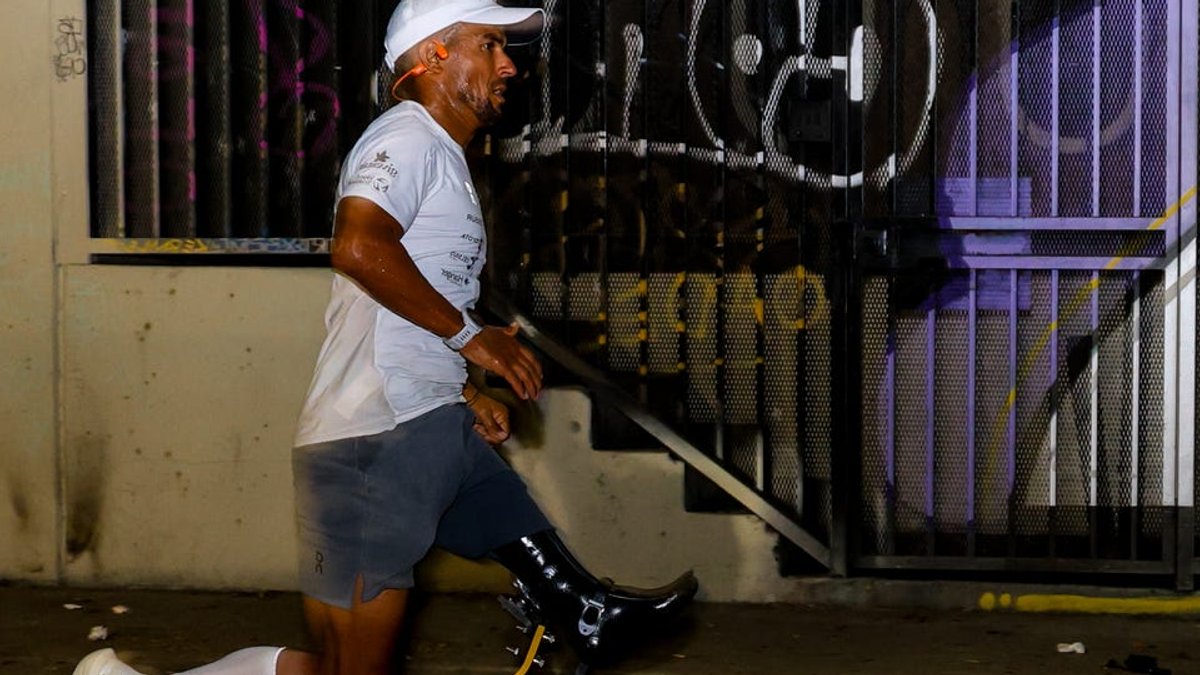
Mohamed Lahna finished the hardest part of his Triathlon Across America two miles at a time. By the time the Paralympic medalist reached the run portion of his 3,300-mile challenge, he had already swum around Manhattan and biked roughly 3,000 miles across the country. What was left was a 300-mile run from Las Vegas to Los Angeles on a prosthesis, including a brutal stretch through the Mojave Desert.
Lahna told Runner’s World that one section between Nevada and California followed power lines for 116 miles through off-road terrain and extreme heat. The route looked endless, and the process had to be slow from the start.
“Running with a prosthesis is very difficult,” Lahna said. “Blisters can stop the journey, and if you get an infection, it is over.”
To manage the risk, Lahna and his crew stopped about every two miles to clean the prosthesis, check his skin, hydrate, and apply BodyGlide or other creams. This routine was not just for comfort; it was the only way to ensure the limb could withstand the daily punishment.
A Battle Against Heat and Friction
“I battled boils and constant pain,” Lahna said. “There were times when we had to stop, treat the wounds, adjust the prosthesis, and find a way to continue.”
Related: Fuel Your Run with Whole Foods
Ultra-endurance events often rely on compartmentalization, where athletes suppress the total distance to avoid being overwhelmed. This mental strategy becomes a physical necessity for adaptive athletes using prosthetics, where the mechanical friction creates a hard limit on how long one can move before maintenance is required. The breakdown isn’t just mental; it is enforced by the equipment.
Lahna told Runner’s World that he kept the run manageable by refusing to think too far ahead. The support car would drive two miles forward and prepare the next hydration break and prosthesis cleaning. His job was just to get there, which he said he “repeated that all day.”
Using that routine, Lahna finished the final stage and reached Venice Beach just after 1 p.m. on July 29. The 3,300-mile effort is believed to be the first triathlon across the United States in this format by an athlete with a prosthesis.
From Manhattan to the Mojave
The entire route started June 13 in New York with a 28.5-mile swim around Manhattan, which Lahna finished in 7 hours, 44 minutes, and 58 seconds. From there, he cycled approximately 3,000 miles to Las Vegas, moving through 16 states and climbing more than 100,000 feet.
About two weeks into the bike, Lahna checked the map and realized he still wasn’t even a quarter of the way across the country. “It was daunting and scary,” he said. “I was tired and exhausted, and I still had so far to go. It felt like I had barely scratched the surface.”
Related: The Best Morning Routine for a Healthier Gut
After that, Lahna said he stopped thinking about the entire route as a whole and focused on the day in front of him. And despite having enough time built in to finish ahead of schedule, his crew convinced him not to get reckless.
“The smart choice was to use the extra time to finish the challenge safely rather than be irresponsible and run too fast,” he said.
Lahna, born in Morocco with proximal femoral focal deficiency, received his first functional prosthesis at 20 and didn’t ride a bike until 25. He went on to take home the Paralympic bronze for Morocco in Rio and silver for Team USA in Paris, with major endurance finishes including the Marathon des Sables, the Ironman World Championship, and Norseman Xtreme Triathlon.
Lahna said he hopes completing this challenge helps more people understand what adaptive athletes manage before they even get to the start line. “For many people, running means putting on a pair of shoes, training, and seeing how far they can go,” he said. “For us, there is much more involved.”
For Lahna, those extra logistics are part of the reality, but most definitely aren’t the whole story. Adaptive athletes are also competitors with “ambitions, a competitive side, and the desire to achieve bigger things,” he said, and he hopes more people will see that.


